
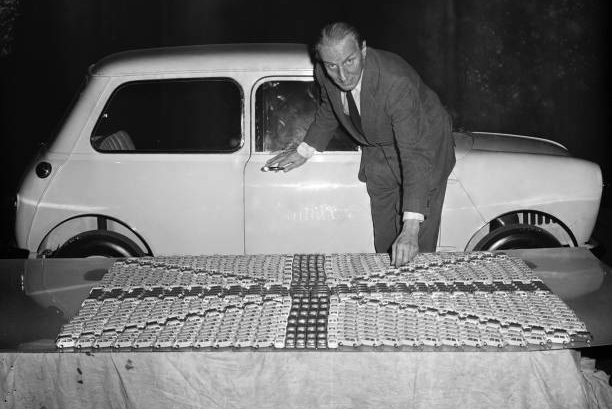
Issigonis is a man who knew what he wanted and compromised very little, which some might say is the reason for his successes with various cars throughout his automotive career. In this ADO Restoration blog, we take a look at Sir Alec Issigonis, the man behind one of Britain’s best-selling car of the 20th century.
The beginning
Issigonis was born in what in was known as Smyrna in Greece (now Izmir, Turkey) and moved to England when he was 16 to pursue his education. He attended Battersea Polytechnic, whereby he paid £3 a term to receive, what he described as, ‘The most wonderful training.’
Born in 1906, Alec Issigonis began his automotive industry career at now-defunct car manufacturer, Humber. Humber produced quality, well-built cars and the brand had many notable fans including The British Royal Family and Sir Winston Churchill.
Issigonis didn’t stop at his time in the Humber workshops, he spent considerable time in the workshop at home and designed his own lightweight version of a supercharged Ulster Austin Seven with his own front axle, which he used to compete in motor racing.
Catching the eye of top bods at Austin, Issigonis was quickly enlisted to work at Austin and from there he moved to the Morris factory in Cowley (the home of course, of the Morris Mini Minor). It was at this time he worked on the Morris 10. During WW2, much effort was concentrated on the war effort, but towards the end, he began working on the Mosquito, the prototype for the car which would become the Morris Minor.
Moving on from the Morris Minor
Alec Issigonis was constantly seeking improvement and innovation and in 1952, the year the British Motor Corporation was form, he decided to move to upmarket automotive brand, Alvis. Alvis had lured Issigonis with the promise of having a blank slate to design a supercar, but in truth, this never truly transpired into anything concrete.
However, whilst at Alvis, he designed an advanced saloon and experimented with suspension. Issigonis saw a future where cars would have interconnected suspension systems, but sadly, this prototype never saw the light of day.
The makings of the Mini
His time at Alvis was brief and in 1955, Issigonis moved to join the newly formed BMC because there was an appetite for a new family of cars. He came in to head up the development of these cars, known already for his successes with the Morris Minor which was heading towards the milestone of being the first British car to sell a million units.
Issigonis came back to familiar faces, including Jack Daniels, an engineer who was by many accounts, an underrated genius. He then brought over Chris Kingham, a talented engineer he’d met through his time at Alvis. It was this trio plus four draughtsmen and two student engineers that brought ADO15 to life.
The brief was tough: Leonard Lord, the BMC Chairman decreed bubble cars were ‘awful’ and BMC had a duty to provide motorists with a ‘proper small car’. Issigonis saw his competition as the Fiat 600 – a practical four-seater which was only slightly larger than the ADO15.
The move towards small cars wasn’t a fashion or a solution to cities which were slowly filling with cars and creating more traffic, it was in response to the Suez oil crisis. Petrol was on ration during 1956 and there was a sharp uptake in smaller motors in response to this.
Issigonis saw the challenge and relished it: he saw the Mini (as it would be known later on) as his chance to maximise use of space, put into action concepts he’d sketched on paper and to create a front wheel drive car; something he felt passionately was the future of motoring.
There were many clever tests and pieces of research done. At one point, Issigonis had various members of staff come and sit on seats within the workshop from the tea ladies to the burly tall men who worked on production lines. He then had them perform basic tasks: sitting down, positioning their legs, opening a map and working out just how much space the ‘average’ user would need to feel comfortable.
The hard work paid off with the launch of the Mini in 1959, at first badged as the Austin Se7en/Austin Seven and Morris Mini Minor.
Issigonis’ values
Issigonis was the perfect person to go forth with the Mini prototype and final creation, because the brief so closely mirrored his personal values.
In an interview from 1979, printed to coincide with 20 years since the launch of the Mini, he was asked about his thoughts on the size of vehicles today and he remarked that small was better: he believed there was nothing worse than large houses, large cars and decreed any car longer than 10ft as ‘too big’. Although we’re not too sure how that correlates with his first success, the 12ft long Morris Minor.
Issigonis had a range of unique views he shared with journalists including a firm belief in not wearing a seat belt whilst driving and a strong conviction the future of cars was a gearless, front wheel drive small car.
He also believed every road accident could be avoided with dutiful driving and said it was the reason he didn’t fear the lack of crash protection in a Mini and also the reason he never smoked at the wheel.
Life after the Mini
Life after the Mini continued at BMC for Issigonis and he oversaw the launch of the ADO16, better known as the 1100 and 1300 cards, the 1800 and the Maxi. These cars took Issigonis’ ideas and brought them to life in what are now highly sought after British classics. These cars sported front-wheel drive, in-sump gearboxes and interconnected suspension.
Some might naturally conclude that the Mini was his favourite creation of his cars for BMC, but actually, he told every journalist who asked that the 1800 was his proudest creation. An interesting conclusion for man who really championed the old saying of ‘good things come in small packages.’
After these genius creations and the formation of British Leyland which replaced the British Motor Corporation in 1968, Issigonis was sidelined by a new influx of engineers led by Harry Webster, who was a Triumph man.
It didn’t mean the end for Issigonis however and he did work on an interesting concept, the 9X programme, which would’ve been a replacement for the Mini and featured a new and innovative gearless transmission system; which was similar to what he fitted to his own Mini he was driving around in the late 70s.
At the beginning of the 70s, Issigonis retired from his role at BL. However, being a man who liked to keep his mind busy, he continued to work in a consultancy role for British Leyland until 1988; only taking a firm retirement from the company a short few months before his death in October 1988.